Tuesday, 26 July 2016

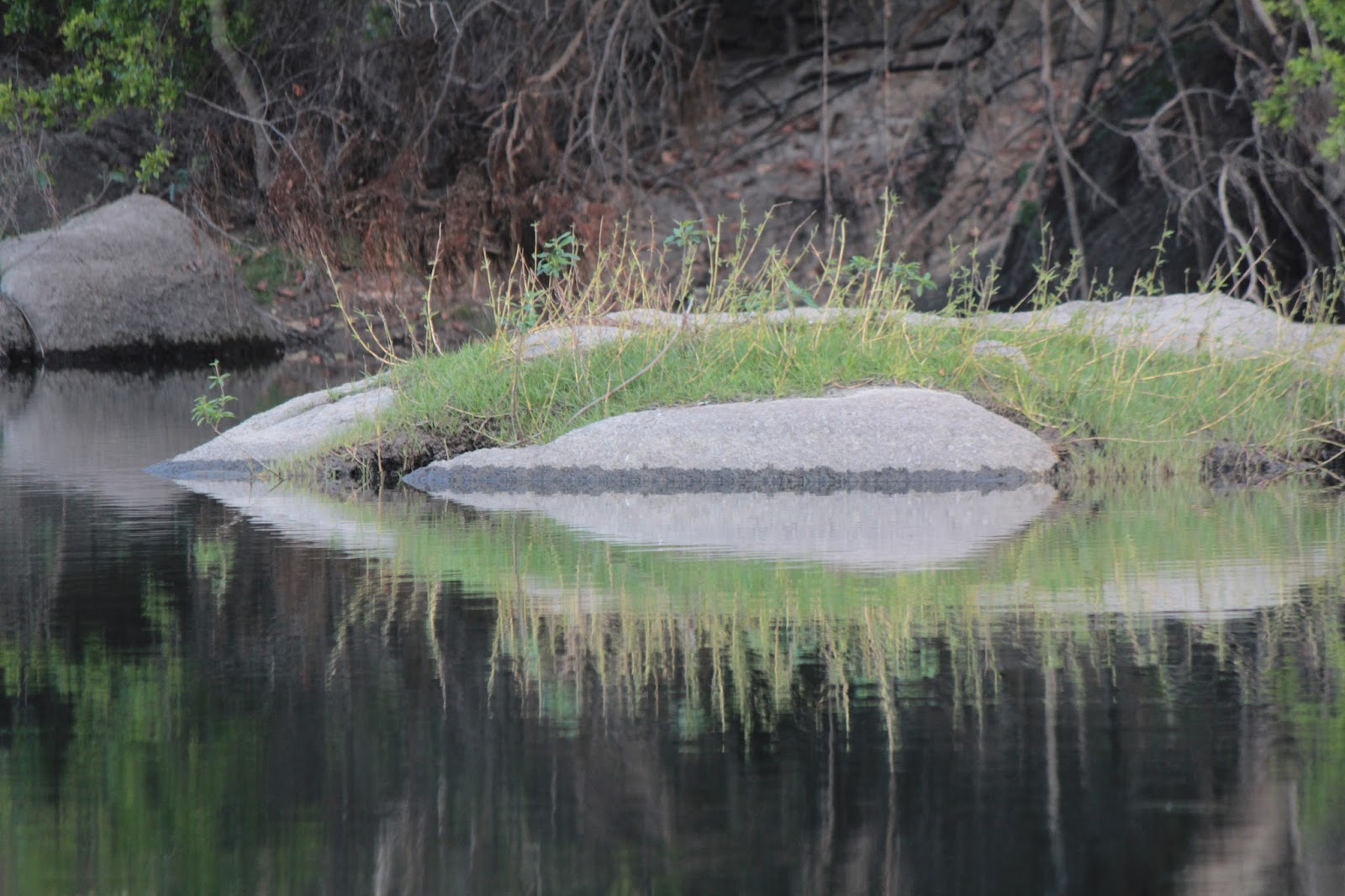
Mystic River, Vagina Flumine


“Hippo on the left”, said my guide Kaley.
We were in canoes, paddling gently down the wild and ancient Kafue River in deepest Zambia. Kaley and I in one canoe; my friend and colleague Sally and her guide in another. 
The Kafue is big and long and flows for nearly a thousand kilometres through Zambia before joining the Zambezi River in Zimbabwe. 
She – this river is definitely a she – is the lifeblood of the Kafue National Park, Zambia’s oldest and biggest.  And very far flung. It took us an hour and a half by air charter, an hour and half by road in a 4x4 and fifteen minutes by boat to get to the remote Kaingu Lodge from Lusaka. A soul spot. Deep soul. 

Now here we were, vulnerable little humans, paddling her ancient waters, trying to hug the banks, dodge the boulders, avoid the hippos. After a bit of initial canoeing in circles, you know, trying to sync paddling and steering.
“Hippo on the left”, said Kaley again, and then: “No that’s not a hippo. Come, paddle faster, let’s go see”, and we paddled furiously towards this scene…

A young male puku – think chunky version of our impala – leapt into the river on the left and started swimming. A massive crocodile leapt into the river from the right and in a few powerful strokes and one mighty snap of the jaws caught the puku and dragged it under.
Snap.
A wriggle and some splashing. Some bubbles.

We canoed over the bubbles.  Kaley and I had a moment of being mutually startled by the life and death scene we had just witnessed, aware that we just happened to be there and see a moment that existed outside of our humanity. "I feel sad for the puku", I said to Kaley, who said the puku must have been chased into the water by a predator, perhaps a lion or a cheetah. I felt happy for the croc though, so prehistorically reptilian-crocodilian, soon to be tummy-full.
And when I looked back, the She River had closed over again. Croc one; puku nought; life moves on, birth, death, life, flow...


Vagina flumine. Flowing vagina.That’s what an old friend commented on this photograph I posted this pic of the Kafue River recently; the metaphor of river as erotic, female, primal, flowing, cyclical. Birth, life, death. It got me thinking about my old friend Thecla and it got me thinking about river porn (snuff in this case) and the wild wet mysterious place I had just been. 

Friday, 15 July 2016

Latitude with attitude


This is one of a series of images that greeted me when I walked into Latitude 15, a hip hotel in the Zambian capital of Lusaka. Insouciant if not downright subversive, these images were taken by Zambian-based French photographer Francois d’Elbee as part of a calendar produced by the hotel. I wanted to applaud, salute, break into song or do a little jig of joy. At last, style with content. A hotel that gives the middle finger to dull décor, regulation-issue melamine, old-fashioned hospitality attitudes and the homophobia so often sadly associated with Africa. Sigh. The Ministry of Fabulousness found its soul home. 

Love this x
Everything from the architecture to the appetizers is a distillate of Zambian homegrown with an international twist. Along with the delightful calendar series, there are paintings and photographs by Zambian and South African artists, like Greg du Toit and Dave Ballam. Dyed ostrich feather hats line the corridors, the lounge features eclectic furniture and fireplaces, stylised wooden benches, recycled glass chandeliers, wooden doors turned into coffee tables. The bedrooms are spacious and sumptuous with privacy and connectivity, never mind the mini bar. Oh bliss.

“Latitude 15 was designed for travellers by travellers”, says James Lightfoot, one of the directors of the Latitude group. “And artwork is one of our defining concepts”. They saw a gap in the market for hip and happening boutique hotels in Africa, he says, and first started Latitude 13 in Lilongwe, then Latitude 15 in Lusaka; both renovated houses resplendent with funky décor and dynamic, spirited hospitality. “The brand”, he says, “is all about social engagement and meeting people”. They also own Kaya Mawa on Likoma Island in the north east of Lake Malawi, one of the sexiest places I have ever visited. And the group has bought properties in Addis Ababa in Ethiopia and Nairobi in Kenya. 

Kaya Mawa, Malawi 
There’s a frenzy of building activity next door to Latitude 15 where the hotel is shortly opening a club called The Other Side, which is a first for Lusaka – a collaborative and dedicated office space offering pods with hot desking and bean bagging, similar to Soho Works in London, or We Work in New York. The idea is for professionals, entrepreneurs and freelancers to be able to work in a private club with high speed Wi-Fi, healthy food and spa and gym facilities.

That's me in the wedding dress 

I wasn’t in the mood for work however. I just wanted to hang out in the lounge and bar, watch the people meet and drink and engage. I went back into the reception to study the calendar photographs. They really are cheeky, ripping off everything from the ad industry, the Mafia and Father Xmas to colonialism and conservatism. There’s even one that has Oscar Pistorius’ blades sticking out of a bathroom door as a Reeva lookalike lies happily in bed reading and the chamber maid cleans up the blood. Oh yes, this is latitude with attitude. Bring it on.
 
Subversive photographs by Francois d'Elbee


Monday, 20 June 2016

Keep on Walking

Fabulous Jomo en route Kenya 
Recently I’ve had the urge to walk out of my life and just keep on walking. To take a soul stroll, step by step, breath by breath, actualising Chinese philosopher Lao Tzu’s saying that the journey of a thousand miles begins with one step. Just because.
And then bing bada boom I met a man who did exactly that. So now I can stay at home with Johnny Walker and live by proxy through the fabulous Jomo from New York who simply upped and left his life. He was en route Cape to Kili - from the fascinating foothills of Cape Town’s flat-topped Table Mountain to Arusha, beneath Tanzania's snow-capped Mount Kilimanjaro. He was eight months into his 5000-km-plus journey, he had a stick, a small back pack, a tent, an ipod and an old-fashioned fold out paper map. He was averaging around 35 clicks a day, had no specific time of arrival in Kenya, and was debating a route change to avoid the Beira Corridor due to rumours of war, and instead walk through Zambia, which would add on another thousand kilometres... then he was going to climb Kili haha, and fly back to NYC.


My friend, delightful Debbie encountered him on Aqua Lane in Tzaneen. He was such eye candy, she admits, she felt compelled to pull over at once and speak to him. Being Debbie and delightful, she suggested he put his feet up for the weekend and arranged him a spot in the soul mountains of Magoebaskloof . Jomo agreed, being tired and skittish after a nasty incident with a racist white farmer in Mpumalanga. Jomo was born of Jamaican parents who immigrated to the USA when he was a kid.
Since he obviously didn’t have a car, it was arranged that I drive him up the mountain from Tzaneen. I picked him up at my rellies’ home in the Nut Village, Macadamia retirement home, where he sat, a bit startled, as the black housekeeper brought the tea in on a silver tray and my Alzheimer’s uncle uttered surreal comments.


“Man, this is the first car I been in for a while”, he said as we drove off. He told me he grew up in Brooklyn, became a doctor, felt essentially unfulfilled and decided to walk out and just keep on walking.  Because he could. And he wanted to. He just needed a very long walk all by himself. A very long one.
I dropped him off at Zwakala Retreat where he relaxed by going on a few hikes, and then he was returned to Tzaneen where he waved goodbye and began walking to Mussina. He planned to cross by foot, over Beit Bridge border post, southern Africa’s busiest and craziest, into Zimbabwe.

“You made these last days in South Africa really great”, was the last email he sent Debbie. “I’ve had such a wonderful time in Limpopo, a province that I was formerly dreading.  You can imagine my surprise when two English cyclists bumped into me on the N1 south of Louis Trichardt and said they had heard of me. I figured you had to be behind it. It’s awesome to think by how thin a margin I ran into them. Had I taken a slightly longer lunch break yesterday, I would have missed them altogether.  These small fortunate occurrences and the beauty in the kindness of strangers have been the highlight of my travel experience. So last night, we all laughed, ate, drank too much wine and generally were merry. Truly a wonderful night.  As it stands I am about three days walk away from the the Zimbabwe border. I’m excited but nervous. Even with all its ups and downs I have gotten used to South Africa and figured out both what to expect and how to survive.  Now I enter into the unknown”.

Both Debbie and I emailed him this weekend but we haven’t yet heard back.  Drop us a line Jomo, and keep on walking, brother.


Monday, 13 June 2016

Missing Melea


In times of mourning and healing, one misses the wise elders. Today I am missing my mogadibo (my darling) Melea Letsoalo, domestic worker for the Hilton-Barber family for almost her entire life. She held me just after I was born and I held her just before she died. She was my anchor, my grandmother, my comforter, my friend. We really adored each other – despite the rule of apartheid at the time, despite her servility in our household. Well into my forties and her nineties, her favourite thing was letting me paint her finger and toe nails post box red, while drinking sweet peach-flavoured champagne. 

Long life! 
Melea cared for me through happiness and heartbreak, through tragedy and trauma – my brother’s death, my armed robbery, me being stabbed in the head. I cared for her too, after her own daughter Carol died, and her son Harry, after her knee conked in and her eyesight faded. Melea was wise and warm, with great humour and healthy streak of anarchy. She was an irrepressible joller. She smoked, she drank. She ran a small but lively shebeen from the alley in Northumberland Avenue in Jozi where we lived for twenty years. 
When I was writing my matric (both my brothers had left home), my parents went overseas for a month and Melea and I were left alone. We had the family Peugeot – and I had a learner’s license - and Melea and I drove all around the suburb visiting my friends and hers. Almost every nearby domestic worker and gardener came to sit in the sun drinking all the stuff we’d raided from the liquor cabinet; as did my friends, but we sat near the pool.  

Colonial family photo 1947
Melea was born in ancestral Letsoalo land in Limpopo, in the green upper reaches of the Letsitele Valley, near Tzaneen. Her people were forcibly removed from there in the 50s. When the land was successfully reclaimed by the Letsoalos in the late 90s, Melea was at the handing back ceremony. “Bloody liar”, she shouted at land minister Thoko Didiza, “all governments are liars!” 

Melea’s father worked for my grandfather on Kings Walden farm in Agatha at the beginning of last century; a skilled stonemason who built the original walls of the now famous gardens. As a teenager Melea went to work on a nearby farm where the farmer tattooed all his workers in case they ran away. Which Melea of course did. I will never forget how I used to trace, with my baby fingers, the warm initials ML in Victorian cursive script on her left inner wrist. 


Not so colonial family photo 1986
Melea fled back to Kings Walden where she went from kitchen ‘girl’ to nanny for my newly born mother Tana. During this time she fell in love with the Portuguese farm foreman, Fernandez, who had come from then Lourenco Marques in Mozambique to manage Kings Walden. Melea and Fernandez lived in a little cottage (which later became mine) and were arrested several times under the Immorality Act in 1948 (no Sex across the Colour Line as it was known then) but continued as lovers ‘til his death in the late 70s. 

Melea eventually retired to a cottage my parents built her in Direpeng Sreet in Lenyenye, down the road from Kings Walden, with a couple of fabulously feisty gogos who smoked newspaper joints and hustled me for bucks to get hot stuff from the local bottle shop. I visited her often there, bearing nail polish, sweet stuff, mielie meal, chickens, eggs, clothes. I got to know her family and relatives, and maintain contact with those still alive and kicking. 

Melea and Tana testing the summer punch 
Born a few days before the Titanic sank in 1912, Melea lived to be 102. I dreamed about her the night before she died. Come quickly said her son Mickey when I phoned the next morning, she is leaving us. I raced down to CN Phathudi Hospital near Lenyenye and saw her for the last time, peaceful and paper thin on the hospital bed.
“I love you”, I said, holding her tiny old hand. “I love you”, she whispered back. 


Love you mogadibo forevah!


Saturday, 11 June 2016

My beautiful crazy cage

In some Freudian, Pink Floyd-ian way, I guess I did exchange a walk on part in a war for a lead role in a cage. Last year I fell in love, took eighteen aeroplanes, travelled nearly 80 000km, went to New York, Hawaii, Malawi, Ilha de Mocambique, Thailand, Maputo twice and Jozi about ten times. I moved house, packed up the family home, wrote another book (watch this space September!), suffered heartbreak and ego’s sorry defeat, moved house again and now here I am, completely exhausted and living in this beautiful crazy cage.
A sun flooded porch enclosed by metal and roses. Burglar bar baroque, art in the face of adversity. It’s at the front of my house on village edge, Haenertsburg heart of the Magoebaskloof in Limpopo, and it overlooks distant mountains and soft green hills and a little school with a very loud bell. I don’t have a fence just a tumble of lawn and shrubbery, nor do I have an actual house number so I am considering making a sign outside: 69 Mandela Corner. 
Being South Africa, fucked-up-cowboy- country, even in this mountain paradise we must live in cages these days, not realising the worst are in our minds, but at least my cage is pretty. My ex-neighbour doesn’t like it. He’s more of a Trellidor kinda guy, and he also has a home security system. At least he doesn’t have a white picket fence.
“These things are bloody horrible”, he said furling his lip at the metal roses. But I think they’re fabulous. Okay they do tend to snag tights, tear jeans and shred shins if you approach the cage too fast under the influence of tequila but hey, at least I’m allowed out. 
And there is astonishing eccentricity beyond my cage. 
I’m new to village life. In between gallivanting, I’ve been based on a remote farm for the past decade or so. Now I can walk to the bookshop and coffee shop, chat to the locals, pop in at the watering holes, you know, generally, stroll around the grounds like Mrs Robinson until I feel at home. 
Love this bookshop
Me being a thrower of pots and this being a village, everyone knew of my sorry heartbreak within about five seconds of it happening and since I moved to the crazy cage I have been showered with typical village loving. You look so sad, said a man in the trading store the other day, let me give you a big hug. You look cold said my new neighbour, here’s a hot water bottle. You look like you need a tequila said a new best friend, here’s a tequila. I may have overplayed the pity card a bit, but this little village has given me so many kind things, from hangovers and takeaways to heaters, hot gossip and colourful tales of their own lives. I am deeply grateful. 
Tired Rasta mop
And since I’m still so tired and yet starting to have fun again, I'm in no real rush to, you know, actually sort out my cage. It's currently a nest of blankets, unpacked boxes and badly stacked books. Only today did I stop using my ice bucket as a fridge and borrowed a real one. I’m not particularly known to be a domestic goddess – I only have one very tired mop that looks like an emaciated Rasta – but I don't care. It's my cage.  


Monday, 18 April 2016

The Relatives of Fabulousness


I could bear my self-pity no longer. I needed to get away from Heartbreak Hill and into loving arms. So I pointed my little white car, Princess, in the direction of Tzaneen and headed down the dizzying Magoebaskloof Pass to have lunch with my aunties and uncles at the Nut Village.
Reasons to be cheerful 
It’s a beautiful, soulful drive and luckily for me, they live next door to each other, so it’s like two for the price of one: One roast chicken and a bottle of wine gets you two momma bear hugs and two avuncular cuddles, on tap. Plus, jackpot, they also have wine. And both uncles are called Mike, so that’s one less name to remember after the wine.  The Nut Village – its real name is the Macadamia Retirement Village – sits calmly and quietly on the banks of the Tzaneen dam and has gorgeous gardens, indigenous trees and a host of extraordinary characters including my fabulous rellies. I always sign into the Nut Village as the Ministry of Fabulousness, and I always cite the reason for my visit as: G&T. 
And it’s always so good to lunch with the aunts and uncles. 
Billo Tooley
We all stem from one Billo Tooley who came farming in Agatha, near Tzaneen, in 1904 and begat the wild Tooley clan who are still alive and kicking and doing everything from politics and cheese making to brewing beer and having their hearts broken. There is strong ancestry and deep love; never a shortage of gossip or wit. I never met him, but Billo Tooley was a strong and handsome (ahem) man, they tell me. He married twice – once to Muriel Frances who started this particular Tooley branch that I lunched with; and then second time to my grandmother Elsie Margaret whose branch and lineage I’m afraid, is unquestionably madder.  Oh dear, that’s me. 
My grandmother Elsie
But I love my aunts and uncles stories. Depending on their moods and the weather, they regale me with tales of avocado farming and the perils of growing cucumbers in subtropical climes; the goings on at the old tennis club and how they found the biggest mashatu tree in deepest Africa. They tell me about how they once took ten children on a flatbed truck to camp in Mozambique for a month, how my mother once hung naked from a tree with my godmother Jean Solomon, how that lot lost everything and that bunch turned out disastrously, how so and so married twenty times and how one aunty once left her baby behind at a party. Mostly we just love each other and love each other’s company. I draw deep from ancestral wells when I lunch with my aunts and uncles at the Nut Village. I leave them with a fuller heart and belly.
The road to the rellies
They are older and wiser people, they have known deeper, greater life and they ease my broken heart, up my humour. They impart love and wisdom and the sense of this lovely quote I found from author  Louise Erdrich that: "Life will break you. You have to love, you have to feel. It is the reason you are here on earth. You are here to risk your heart. You are here to be swallowed up. And when it happens that you are broken, or betrayed, or left, or hurt, or death brushes near, let yourself sit by an apple tree (or in our case an avocado tree) and listen to the apples falling all around you in heaps, wasting their sweetness. Tell yourself you tasted as many as you could."


Friday, 15 April 2016

The best of times, the worst of times

Tintin my man! 
If I hadn’t have fallen in love I wouldn’t have had my heart broken. But if I hadn’t had my heart broken I would never have found out that I am related to Tintin! 
OMG can you believe it?! 
It’s almost worth the pain.
Mysteriously, there is no Belgian blood in my veins. I am thoroughly South African, but ancestrally English, Scottish and Irish, and I had a bit of Welsh in me recently until the fucker betrayed me and went back to the environs of Cardiff.  But Tintin himself actually wrote to me in person the other day, and the fact that I had a cat called Snowy once is now extraordinarily auspicious.
“Dear Bridget”, wrote Tintin – after my last blog about meandering morosely and miserably about the local cemetery - “What a wonderful blog. You are my 1st cousin of the husband of my 6th cousin Eleonore Dorothy Melck. My Mum’s ashes are in the Haenertsburg cemetery and so will mine and my partners be one day. Also buried there is the wife of my 2nd great-uncle. Eliza Devenish nee Short. She knew General Piet Joubert and her father was a friend of Charles Dickens.”
Tintin Joubert 
At this point I feel I must mention that this Tintin’s surname is Joubert. Not that that changes anything of course. If anything, it adds a certain frisson to the overall mystery. I am obviously delighted to be connected to Tintin, who according to both popular mythology and Wikipedia, “had a sharp intellect, could defend himself, and was honest, decent, compassionate, and kind. Through his quick thinking, and all-round good nature, was always able to solve the mystery and complete the adventure.” That’s pretty much me, isn’t it?  Apart from the completing the adventure part, perhaps, and er, maybe solving the mystery. Mmmmm, decent, compassionate, kind, ok well whatever…
But to be entirely honest, I am not that happy about the Joubert connection, since Commandant General Piet Joubert was the man who ordered the beheading of Chief Makgoba, a local chief here in Magoebaskloof in the 1800s. During what they call the Boer-Makgoba Wars, Joubert ordered a team of Swazi bounty hunters to flush Chief Magkoba out of the deep forests, and return with his head, which they did. There is a great deal of local lore and legend about Makgoba, and the whereabouts of his head remains a mystery although I have it on pretty good authority that it’s somewhere in Germany in the household of the family Altenroxel.
Deep in the Magoebaskloof forests 
Never mind. The fact that my Tintin’s relatives – and therefore mine – knew Charles Dickens is of course a huge upside. So let’s skip the heartbreak and the beheadings and the torrid stuff – and let me leave you with this Dickensian profundity, which could apply to anything from politics to heartbreak. It’s from A Tale of Two Cities, and it reads thus: “It was the best of times, it was the worst of times, it was the age of wisdom, it was the age of foolishness, it was the epoch of belief, it was the epoch of incredulity, it was the season of Light, it was the season of Darkness, it was the spring of hope, it was the winter of despair…”